Agentic AI vs Traditional Integration: The Future of Enterprise Connectivity
In today’s fast-paced digital landscape, businesses are under constant pressure to operate smarter, faster, and more efficiently by integrating multiple systems they use for different purposes by different teams without compromising on security, data integrity and reliability.
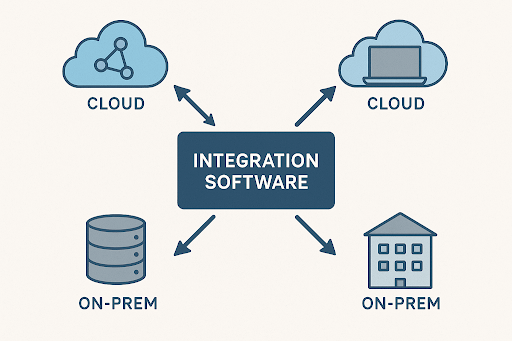
Traditionally, enterprise systems have relied on integrating with other systems using middleware technologies for data loads/transformations and trigger workflows (in specific use cases). But as Artificial Intelligence is evolving, becoming more accessible and embedded into enterprise applications, a new player is emerging, i.e., Agentic AI.
Agentic AI represents a paradigm shift from reactive to proactive integration. Unlike traditional AI that waits for input and performs narrow tasks, agentic AI systems can perceive their environment, reason through multiple potential outcomes, and execute actions autonomously. These intelligent agents promise not just automation, but contextual decision-making that evolves with your data without compromising on security and integrity. Now modern businesses need to make smart decisions on adapting to the Agentic AI (or any other AI) and evaluate the need for traditional integrations (can also be any other static solution they follow). In this blog, we’ll explore how Agentic AI differs from traditional integration and which approach is best suited for your business needs.
What is Traditional Integration?
Traditional integration involves predefined rules and configurations to move data and coordinate systems. This can include middleware, ETL pipelines, API connections, and batch file exchanges. Though effective, these systems are often rigid, require extensive setup, and are labor-intensive to maintain.
What is an Agentic AI?
Agentic AI, such as Oracle Fusion AI Agents, leverage AI and ML to autonomously analyze enterprise data, identify issues or opportunities, and act upon them without manual intervention. These agents are context-aware and learn over time, making them suitable for dynamic business environments. Unlike traditional AI, which follows fixed rules or responds to prompts in a one-off manner, agentic AI adapts dynamically to complex tasks, collaborates with other systems, and iterates on its processes. This evolution is reshaping how applications integrate with each other, moving away from rigid, predefined connections toward more flexible, intelligent orchestration.
Key Differences between Agentic AI and Traditional Integration:
The table below highlights how Agentic AI–enabled integrations differ fundamentally from traditional integration architectures in terms of structure, adaptability, scalability, and intelligence.
| Aspect | Traditional Integrations | Agentic AI–Enabled Integrations |
|---|---|---|
| Structure | Rigid, rule-based workflows tied to static endpoints | Dynamic, goal-driven architecture with reasoning and feedback loops |
| Adaptability | Limited; prone to failure with schema or API changes | Continuously self-adapts using memory, context awareness, and feedback |
| Automation Scope | Executes predefined, repetitive integration tasks | Handles complex, cross-domain workflows with autonomous orchestration |
| Human Involvement | High manual monitoring and intervention | Low-touch; agents act autonomously and escalate only exceptions |
| Scalability | Expansion requires manual coding or new pipelines | Modular agent architecture scales seamlessly through collaboration |
| Learning Capability | Static logic; no built-in feedback or improvement mechanism | Continuously self-learns through feedback loops and evolving data |
| Testing Approach | Static test cases defined during build time | Requires adaptive and context-aware dynamic testing strategies |
| Observability & Monitoring | Log-based dashboards and manual threshold alerts | Proactive anomaly detection and autonomous remediation actions |
| Governance & Compliance | Governed manually through approval workflows | Integrated governance where agents follow policy-driven decision boundaries |
| Examples | Static API calls, ETL jobs, middleware pipelines | AI agents orchestrating SaaS data flows, RAG, and DevOps automations |
Advantages of Agentic AI
- Adaptive and Data-Driven Workflows: Agentic AI continuously learns from operational data and user behavior to dynamically adjust integration flows, optimize orchestration patterns, and align with evolving business needs enabling systems to self-tune over time.
- Embedded within business applications: Agentic AI can be natively embedded into enterprise applications and integration platforms, eliminating the dependency on external orchestration tools and enabling context-aware intelligence directly within business workflows.
- Lower long-term maintenance: Agentic-AI reduces long-term maintenance of the application by self-healing and self-adaption.
- Cross-Agent Collaboration: Multiple AI agents can coordinate across different systems such as ERP, CRM, and integration platforms, to autonomously exchange data, trigger workflows, and maintain end-to-end process continuity without human orchestration.
- Real-time insights and actions: Agentic AI can continuously monitor systems data in fact any custom application integrating multi systems, can detects anomalies or performance issues in real time and takes corrective actions autonomously without manual intervention. This ensures uninterrupted and adaptive data synchronization across systems.
- No Code and user centric development: Through natural language or guided prompts instead of coding which simplifies development. Agentic AI empowers business and functional users to build integrations with less technical knowledge.
Limitations of Agentic AI
- Still maturing in terms of capabilities: Agentic AI is an emerging technology which is still evolving which can lead to gaps in development with limited adaptability to complex enterprise scenarios.
- Data quality and governance are crucial: Agentic AI relies on clean, well-governed datasets and consistent metadata to generate accurate mappings, transformations, and decisions; inadequate data lineage, validation controls, or schema governance can propagate errors across interconnected integrations and compromise system reliability.
- Limited Support for Complex Legacy Scenarios: Many legacy systems still rely on flat files, proprietary adapters, or stored procedure-based integrations that lack standardized metadata or API definitions. In such cases, Agentic AI struggles to infer data semantics or automatically generate mappings, because there’s no machine-readable structure to learn from.
- Requires trust in AI decision-making: Agentic AI autonomously designs, modifies, and executes integrations, making transparency and auditability critical; without explainable reasoning or governance controls, organizations may find it difficult to fully trust AI-driven actions in production environments.
- Dependence on LLM Engines: Agentic AI behavior is tightly coupled with the underlying large language model; updates or retraining of the LLM can unintentionally alter the agent’s reasoning, response patterns, or integration logic, impacting consistency and reliability across deployments.
- Dynamic Testing Strategies Required: Since Agentic AI behavior evolves with context and learning, traditional static test cases are insufficient; enterprises must implement adaptive, scenario-driven testing frameworks that validate AI decisions and outcomes dynamically over time.
Evaluate the use case
Agentic-AI is ideal for automating repetitive, data-driven tasks (e.g., invoice approvals, talent acquisition suggestions), while traditional integrations remain essential for structured, system-to-system transactions, handling complex mappings, control over the code.
The choice between agentic AI and traditional integrations is strategic. While traditional integration methods continue to serve many enterprises needs effectively, agentic AI represents the future of intelligent, adaptive system connectivity.
Organizations should consider agentic AI when they need:
- Dynamic adaptation to changing business requirements
- Autonomous handling of complex integration scenarios
- Proactive problem resolution and optimization
- Scalable architecture for rapid business growth
Traditional integrations remain appropriate for:
- Stable, well-defined integration requirements
- Highly regulated environments requiring predictable behaviour
- Organizations with limited AI expertise or investment capacity
- Critical systems where autonomous decision-making poses unacceptable risks
The organizations should likely adopt a hybrid approach, leveraging the reliability of traditional integrations for core systems while deploying agentic AI for dynamic, complex integration challenges. As the technology matures and organizational capabilities develop, the balance will inevitably shift toward more intelligent, autonomous integration solutions.