
Streamlining Cloud Messaging: Connecting AWS SNS and SQS with Oracle Integration Cloud
In today’s distributed cloud environments, applications must communicate asynchronously to remain scalable and resilient. Amazon Web Services (AWS) provides powerful messaging services like SNS (Simple Notification Service) for publish-subscribe (pub-sub) patterns and SQS (Simple Queue Service) for reliable message queuing. However, the real challenge lies in connecting these cloud-native services with your core enterprise systems, such as Oracle Finance.

This is where Oracle Integration Cloud (OIC) becomes essential. OIC acts as a middleware layer, using its robust adapters to bridge the gap seamlessly between AWS messaging services and your other business applications. This blog post will provide an overview of how to connect AWS SNS and SQS using OIC, its benefits, and how it can transform your integration architecture.
What is an OIC-AWS Messaging Integration?
An OIC-AWS messaging integration is a configuration within Oracle Integration Cloud that allows OIC to either listen to the message from SQS queues or send messages to SNS topics and SQS queues. OIC leverages the AWS Adapter to handle security, connectivity, and data transformation, eliminating the need for complex custom code and enabling rapid development of event-driven real-time integrations
SNS (Simple Notification Service) Topic, is a fully managed pub/sub service that completely decouples microservices and distributed systems. It allows a producer to publish once to the topic, then SNS Topic pushing messages simultaneously to various subscribers such as Lambda, SQS, email, SMS, and HTTP/S.
Oracle Integration Cloud (OIC) can act as publisher to send messages directly to an SNS topic, seamlessly kicking off downstream event-driven workflows.
SQS (Simple Queue Service) Queue, is a fully managed message queue where messages wait until a consumer polls and processes them, ensuring reliable decoupling and fault tolerance through Dead Letter Queues (DLQ) and FIFO ordering.
Oracle Integration Cloud (OIC) can use the AWS SQS adapter to seamlessly consume from SQS Queue, bridging the queue directly with your integration workflows. Additionally, OIC AWS SAS adapter can publish messages to SQS Queues.
Key Features and Benefits of OIC Integration
- Decoupled Architecture: Allows AWS-native applications and enterprise systems (like Oracle ERP) to operate independently, improving fault tolerance and scalability
- Guaranteed Message Delivery: By using SQS, you ensure that messages are stored reliably until they are successfully processed by a downstream application or OIC.
- Powerful Fan-Out Pattern: Use SNS to publish a single message (e.g., “Payment Completed”) and OIC to subscribe to it. OIC can then “fan-out” this message to multiple destinations, such as an Oracle ERP Or any third-Party application.
- Enhanced Security: Robust security measures ensure the confidentiality and integrity of your data.
- Native Connectivity: OIC’s pre-built AWS adapter simplifies connections, handling authentication
- Simplified Error Handling: OIC provides built-in error handling and retry mechanisms, making it easier to manage failed messages from an SQS queue to dead letter queue.
- Automatic Message Cleanup: When an OIC integration successfully polls a message from Amazon Simple Queue Service (SQS), the OIC Amazon SQS Adapter automatically removes the message from the queue. Messages remain hidden during the configured Visibility Timeout period and reappear if they are not successfully polled before the timeout expires. If repeated failures exceed the configured maxReceiveCount, SQS automatically moves the message to the configured Dead Letter Queue (DLQ).
How the Integration Works?
Oracle Integration Cloud can interact with SNS and SQS using the AWS Adapter.
- Consuming Pattern: OIC Consuming from an SQS Queue (Event-Driven)
- Create an OIC integration by configuring AWS Adapter as a trigger point.
- Configure the Adapter with the SQS queue details.
- The OIC integration can receive the message when a message is published to queue. Upon the message is polled by OIC, the message is removed from the SQS queue.
Finally, OIC processes the message (e.g., updates a record in an Oracle ERP or creates a receipt)
- Publishing Pattern: OIC Publishing to an SNS Topic (Event-Driven)
- Create an OIC integration to publish messages to an AWS SNS topic using the AWS Adapter.
- Upon a business event triggered in Oracle Fusion (e.g., invoice creation or order processing), the OIC integration listens and reads the business event message and then transforms the payload.
- Finally, publish the message to the SNS topic.
- Further, AWS SNS delivers the message to all the configured subscribers, such as SQS queues, Lambda functions, email endpoints, or HTTPS endpoints, enabling downstream event-driven processing.
Use Cases for AWS SNS and SQS with OIC
These integration patterns are perfect for automating critical financial close and reconciliation processes. The following use cases explain the automation on how your payment-to-receipt and financial reporting data flows using OIC, AWS, and Oracle ERP.
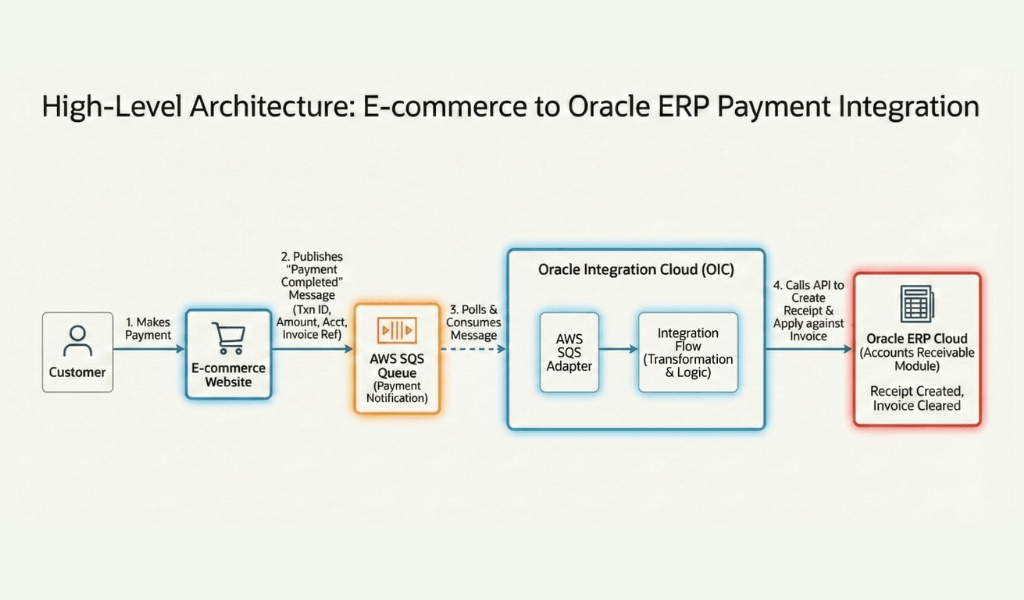
1. Payment Notification (SQS) – Consuming Pattern
-
- Use Case: When a customer makes a payment on the e-commerce website, that payment information needs to be captured and recorded in Oracle ERP. Specifically, a Receipt must be created in the Oracle Accounts Receivable (AR) module and applied against the customer’s open invoices. Without automation, finance teams manually enter this payment data into Oracle AR, causing delays in cash application, reconciliation mismatches, and inaccurate aging reports.
- Solution: Once the customer completes a payment on the e-commerce website, a “Payment Completed” message — containing transaction ID, payment amount, customer account, and invoice reference — is published in an AWS SQS queue. OIC polls the queue and triggers message arrival. Using the Oracle ERP Cloud Adapter, OIC creates a Receipt in Oracle AR for that payment and automatically applies it against the customer’s matching open invoices, clearing the outstanding balance in real time.
2. Outbound ERP Data Sync – Publishing Pattern
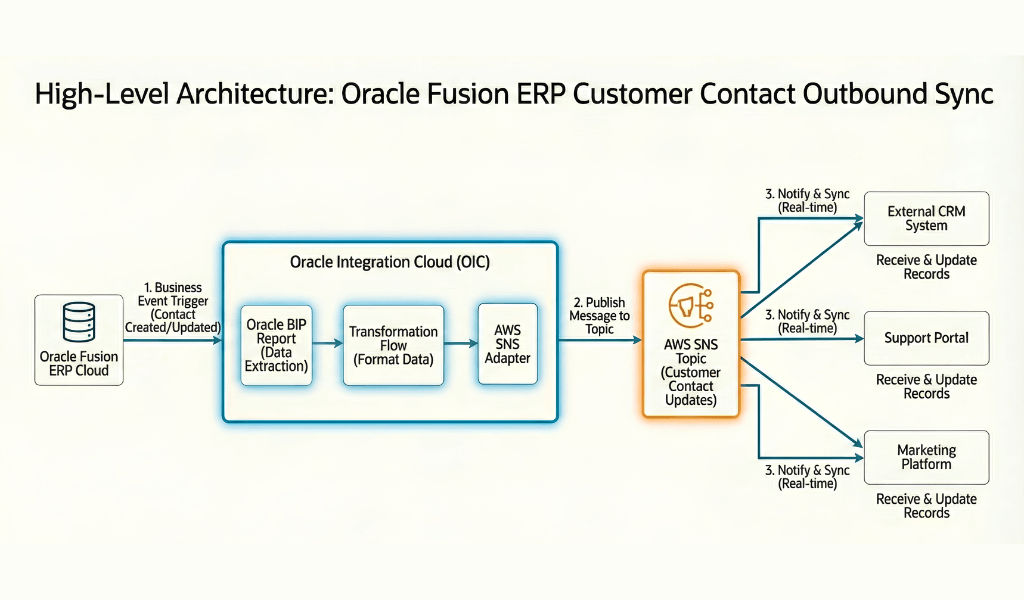
- Use Case: Whenever a customer contact is created or updated in Oracle Fusion ERP, that information needs to be made available to external systems so they can stay in sync with the latest customer data. Without automation, external systems rely on manual extracts or scheduled batch files to get updated contact information, leading to stale data, mismatches, and delays in downstream processes.
- Solution: When a customer contact is created or updated in Oracle Fusion ERP, OIC listens to the corresponding Oracle ERP Business Event and triggers the outbound sync in near real time. OIC captures the updated contact details, transforms the data into the required format, and publishes it to AWS SNS. External systems subscribed to the SNS topic receive the notification instantly and update their records. Accordingly, ensuring all connected systems always have the most current customer contact information from Oracle Fusion.
Conclusion
Connecting AWS SNS and SQS with Oracle Integration Cloud is a powerful and essential pattern for modern enterprise architecture. It allows businesses to leverage the best of both worlds: AWS’s scalable and cost-effective messaging services, and OIC’s robust orchestration, transformation, and enterprise connectivity.
By using OIC as the central hub, you can build event-driven integrations that are reliable, maintainable, and seamlessly connected to your core business applications.
Ready to build robust, event-driven integrations with OIC and AWS? Contact us today to learn more about how we can help you implement this solution and unlock its full potential.