A Practical Guide to Understanding OIC Message Consumption
When organizations adopt Oracle Integration Cloud (OIC), one of the most common questions from architects, administrators, and customers is:
“What exactly is considered a message in OIC, and how are messages calculated?”
Understanding message consumption is critical because it directly impacts licensing, scalability, cost estimation, and integration design. Many teams assume every API call counts as one message, but Oracle follows a more specific methodology.
This article provides a practical understanding of Oracle Integration Cloud (OIC) message calculation. We’ll begin by explaining what a message is in OIC, rules for tracking the messages, walk through how Oracle calculates billable messages, and highlight common design mistakes that can unnecessarily increase message consumption.
What is a Message in Oracle Integration Cloud?
A message is the unit Oracle uses to measure the amount of data processed through Oracle Integration Cloud.
Whenever data enters or leaves an integration, OIC measures the payload size to determine how many messages have been consumed.
A message is not simply:
- One integration execution
- One REST API call
- One file processed
Instead, Oracle calculates consumption primarily based on the payload size.
Why Does Message Calculation Matter?
Understanding message calculation helps organizations:
- Estimate licensing requirements
- Predict monthly usage
- Avoid unexpected overages
- Design efficient integrations
- Optimize large file processing
For customers processing millions of transactions every month, proper message calculation can significantly reduce licensing costs.
Oracle Integration Message Rate
Oracle Integration licensing is based on message consumption, with the applicable message limits measured per hour or per month, depending on the OIC license type.
For Example, The standard Oracle Integration subscription provides: 5,000 messages per hour
This means:
- Every hour, your OIC instance can process up to 5,000 billable messages without requiring additional message packs.
- If your workload consistently exceeds this limit, additional capacity or message packs may be required depending on your subscription model.
Note: The exact entitlement depends on your Oracle Integration edition and licensing agreement (Standard, Enterprise, BYOL, Oracle Integration for SaaS, etc.). Always verify your purchased entitlement with your Oracle order document.
Message Calculation Should Be Considered During Solution Design
Many implementation teams start thinking about message consumption only after production deployment, when they notice higher-than-expected usage. Message estimation should begin during the solution architecture phase.
Before designing integrations, architects should evaluate:
- Expected transaction volumes
- Average payload sizes
- Frequency of execution
- Peak-hour processing requirements
- Growth projections over the next few years
This information helps determine whether the selected Oracle Integration subscription is sufficient and avoids unexpected licensing discussions later in the project.
Message estimation should be treated as an essential activity during solution sizing, just like performance and security planning.
Rules for Tracking Messages
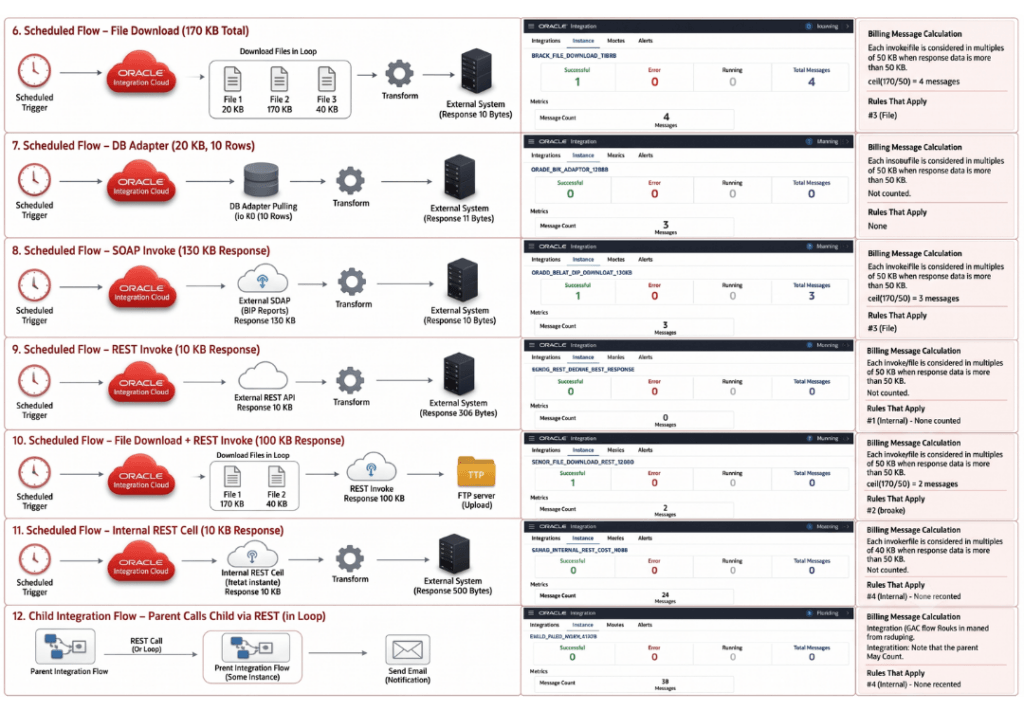
How Oracle Actually Calculates Messages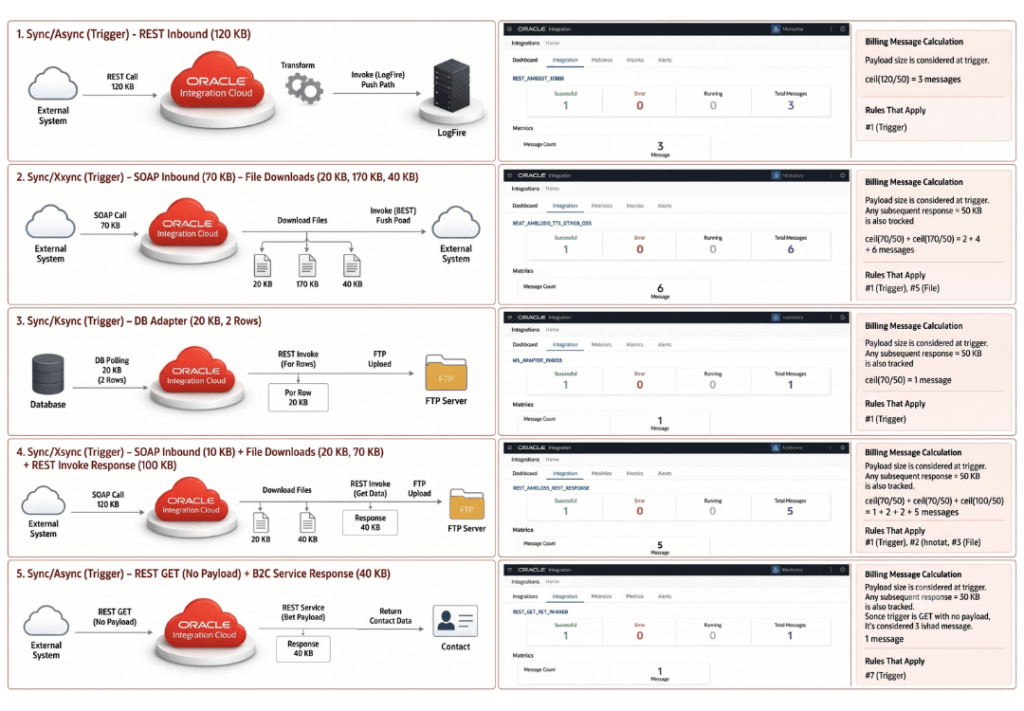
Reference Documentation: OIC Billable Messages Calculation
Common Mistakes That Increase Message Consumption
❌ Returning all columns from ERP
❌ Reading entire database tables
❌ Sending huge XML payloads
❌ Passing Base64 attachments unnecessarily
❌ Retrieving thousands of records when only a few are needed
❌ Ignoring pagination
Frequently Asked Questions (FAQ)
Q1. Does each integration instance consume one message?
No. Message consumption depends primarily on the payload size processed, not the number of integration instances.
Q2. Does each REST API call consume one message?
Not necessarily. A single REST call with a payload larger than 50 KB can consume multiple messages.
Q3. Do failed integrations still count toward message consumption?
Yes. If OIC has already received and processed the payload before the failure occurs, the message consumption has already taken place.
Q4. Do retries consume additional messages?
Yes. Each retry processes the payload again and therefore contributes to additional message consumption.
Q5. Do scheduled integrations consume messages even if no records are returned?
Generally, if the integration executes but processes no payload, message consumption is minimal or may not be incurred for data processing. However, the exact behavior depends on the integration pattern and what data is actually processed.
Final Thoughts
As an Oracle Integration Architect, I always recommend treating message consumption as a design KPI (Key Performance Indicator) rather than just a licensing metric. During solution design reviews, my team evaluates not only whether an integration works correctly, but also whether it is efficient. Questions such as “Can the payload be reduced?”, “Can we process only changed records?”, “Are we making unnecessary API calls?” are part of every design discussion. These small architectural decisions can save millions of processed messages annually in high-volume environments, while also improving performance and reducing operational costs.
Oracle Integration Cloud message calculation is not just about licensing—it’s a reflection of integration architecture quality. Well-designed integrations naturally consume fewer messages because they transfer only the data that delivers business value. By understanding how Oracle measures messages, architects can build solutions that are scalable, performant, and economically efficient from day one.