A Practical Architect’s Guide to Oracle Integration Cloud (OIC) Licensing
Introduction
Oracle Integration Cloud (OIC) has become the strategic integration platform for organizations looking to connect Oracle Fusion Cloud applications, third-party SaaS applications, on-premises systems, APIs, databases, and enterprise applications. As organizations modernize their integration landscape, one of the most common questions architects and customers face is:

“Which Oracle Integration Cloud license is the right fit for my organization?”
The answer isn’t always straightforward. Oracle offers multiple licensing options that are often misunderstood because three different concepts are involved:
- Consumption Models – How Oracle Integration Cloud is purchased and billed.
- License Types – How the OIC license is acquired.
- OIC Editions – The functional capabilities available within Oracle Integration Cloud.
These concepts are independent of one another, yet together they determine how Oracle Integration Cloud is licensed, deployed, and consumed.
For example, a customer may choose the Universal Credits consumption model, purchase it as a New License, and deploy the Enterprise Edition. Another customer may choose the Subscription (OIC4SaaS) consumption model, leverage BYOL, and deploy the Standard Edition. Understanding these options early in the project helps organizations optimize licensing costs while ensuring they have access to the capabilities required for their integration strategy.
In this blog, we’ll take a practical, architect-focused approach to Oracle Integration Cloud licensing. We’ll explore the available consumption models, understand the different license types, compare the OIC editions, and provide guidance on selecting the most appropriate licensing option based on your organization’s business and technical requirements.
Understanding Oracle Integration Cloud Licensing
Before diving into the individual licensing options, it’s important to understand how Oracle structures OIC licensing.
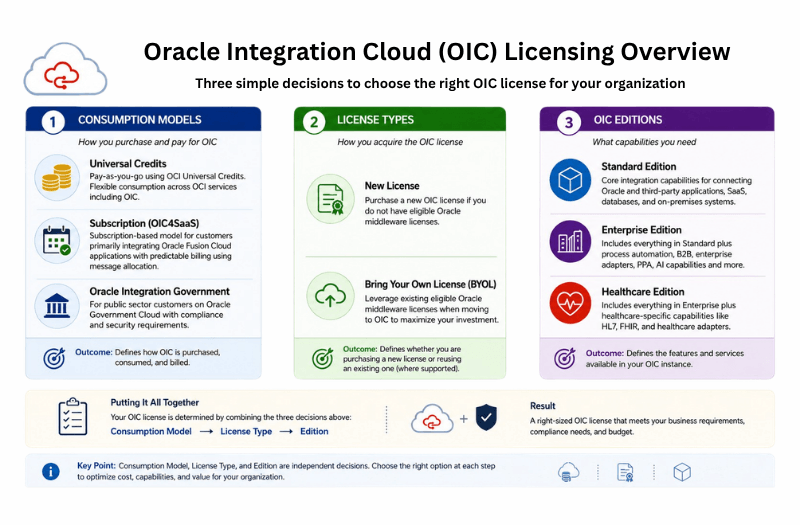
Oracle Integration Cloud licensing can be viewed as three independent decision layers:
- Consumption Model – Defines how Oracle Integration Cloud is purchased and billed.
- License Type – Determines whether you purchase a new license or reuse an existing Oracle middleware license.
- Edition – Determines the capabilities and services available within your OIC instance.
Think of it as answering three questions:
- How will I pay for Oracle Integration Cloud?
- Am I purchasing a new license or reusing an existing one?
- Which capabilities do I need?
Answering these questions in the right order makes selecting an OIC license much simpler.
OIC Consumption Models
The Consumption Model is the first licensing decision an organization should make because it determines how Oracle Integration Cloud is purchased, consumed, and billed.
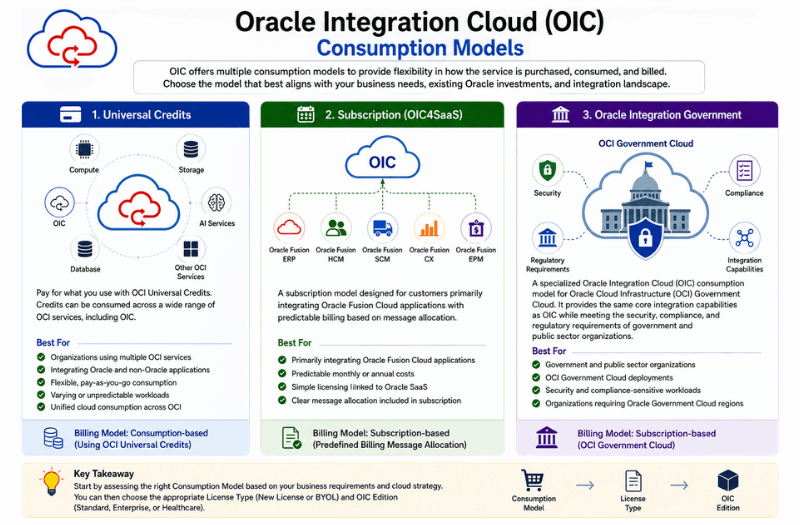
Oracle currently offers three consumption models:
- Universal Credits
- Subscription (OIC4SaaS)
- Oracle Integration Government
Each model is designed to support different customer scenarios and cloud adoption strategies.
Universal Credits
Universal Credits is Oracle Cloud Infrastructure’s (OCI) flexible pay-as-you-go or committed consumption model. Instead of purchasing a dedicated OIC subscription, customers purchase OCI credits that can be consumed across a wide range of OCI services, including Oracle Integration Cloud.
This model provides maximum flexibility and is ideal for organizations running multiple OCI services alongside OIC.
Best suited for: Large enterprises, hybrid cloud environments, and organizations adopting Oracle Cloud Infrastructure as their strategic cloud platform.
Subscription (OIC4SaaS)
The Subscription (OIC4SaaS) model is specifically designed for customers primarily integrating Oracle Fusion Cloud applications such as ERP, HCM, SCM, CX, and EPM. Instead of consuming OCI credits, customers subscribe to Oracle Integration Cloud based on a predefined billing message allocation.
This model provides predictable licensing costs and is optimized for Oracle SaaS integrations.
Best suited for: Oracle Fusion ERP, HCM, SCM, CX, and EPM customers implementing application integrations.
Oracle Integration Government
Oracle Integration Government is a specialized Oracle Integration Cloud (OIC) consumption model designed for organizations that operate in Oracle Cloud Infrastructure (OCI) Government Cloud environments. It provides the same core integration capabilities as Oracle Integration Cloud while meeting the security, compliance, and regulatory requirements expected by government and public sector organizations.
Unlike the standard Universal Credits and Subscription (OIC4SaaS) consumption models, Oracle Integration Government is intended for customers whose workloads must run in Oracle’s government cloud regions.
Best suited for: Government and public sector organizations requiring Oracle Integration Cloud in OCI Government Cloud.
OIC License Types
Once you’ve selected the appropriate consumption model, the next step is to determine how the OIC license will be acquired.
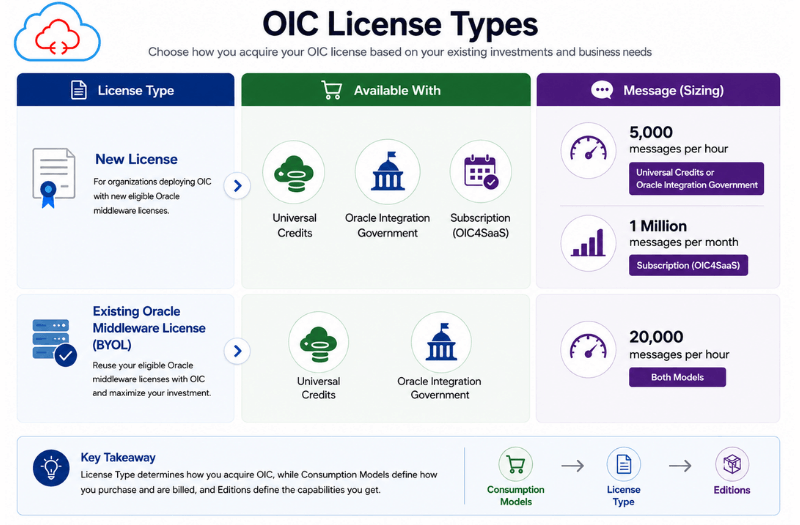
Oracle Integration Cloud (OIC) offers two licensing options that determine how organizations acquire and consume the service:
- New License
- Bring Your Own License (BYOL)
Unlike Consumption Models, which define how the service is billed, or Editions, which determine the features available, License Types define how an organization obtains the OIC license. The choice between a New License and BYOL primarily depends on whether the organization already owns eligible Oracle middleware licenses.
Selecting the appropriate license type can significantly impact licensing costs and help organizations maximize their existing Oracle investments.
New License
A New License is intended for organizations that are adopting Oracle Integration Cloud for the first time or do not own eligible Oracle Middleware licenses. Under this model, customers purchase a new OIC license based on their chosen consumption model (Universal Credits or Subscription).
This option provides access to the latest Oracle Integration Cloud capabilities without requiring any previous Oracle middleware investment.
Bring Your Own License (BYOL)
The Bring Your Own License (BYOL) option allows organizations with existing eligible Oracle middleware licenses to migrate to Oracle Integration Cloud while reusing their on-premises license investment. Instead of purchasing a completely new license, customers can leverage their existing Oracle licenses, making cloud adoption more cost-effective.
BYOL is particularly beneficial for organizations migrating from Oracle SOA Suite or other supported Oracle Middleware products to Oracle Integration Cloud.
Note: Oracle Integration licensing, editions, message entitlements, and consumption models may change with Oracle Integration (Gen3) updates and future Oracle licensing revisions. Always refer to the latest Oracle documentation before making licensing decisions.
Oracle Integration Cloud Editions:
Oracle Integration Cloud (OIC) is available in three editions—Standard, Enterprise, and Healthcare. Each edition is designed to address different business and integration requirements. While all editions provide core integration capabilities, higher editions include additional enterprise and industry-specific features. Choosing the right edition depends on the complexity of your integration landscape, automation requirements, and industry-specific needs.
- Standard Edition:
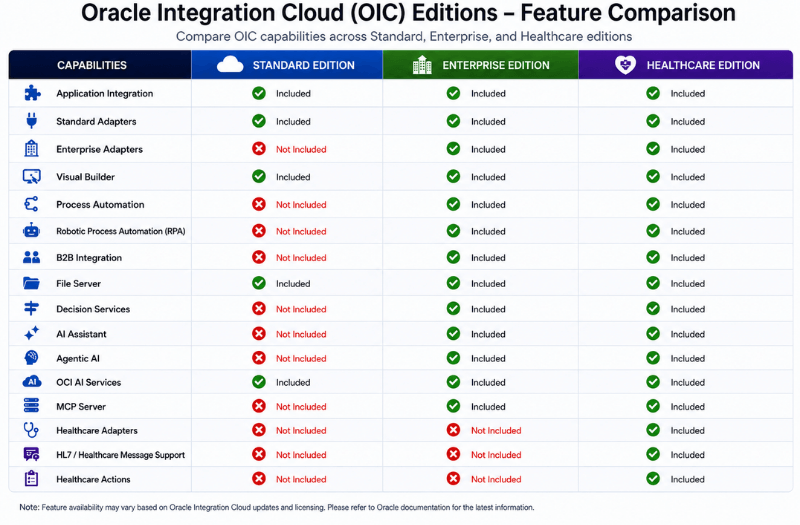
The Standard Edition is designed for organizations that require core application integration capabilities. It enables seamless connectivity between Oracle Fusion Cloud applications, third-party SaaS applications, databases, and on-premises systems using standard adapters and low-code integration development. This edition includes capabilities such as Application Integration, Visual Builder, File Server, OCI AI Services.
- Enterprise Edition:
The Enterprise Edition builds upon the Standard Edition by introducing advanced enterprise integration and automation capabilities. In addition to all Standard Edition features, it includes Process Automation, B2B integration, Enterprise Adapters, Decision Services, Robotic Process Automation (RPA), Agentic AI capabilities, and MCP Server support. It is intended for organizations with complex integration ecosystems that require business process orchestration and enterprise-scale connectivity.
- Healthcare Edition:
The Healthcare Edition extends the Enterprise Edition by providing capabilities specifically designed for healthcare interoperability. It includes all Enterprise Edition features along with healthcare-specific adapters, actions, and support for industry standards such as HL7 and FHIR. This edition enables seamless integration with Electronic Health Record (EHR) systems, laboratories, hospitals, and other healthcare applications.
Comparison of All Editions
Here’s a side-by-side comparison of what’s licensed in each edition.
Note: The Standard, Enterprise, and Healthcare editions define the functional capabilities available within Oracle Integration Cloud. They are independent of the consumption model (Universal Credits, Subscription/OIC4SaaS, or Oracle Integration Governance), which determines how the service is licensed and billed. Understanding this distinction is important when selecting the right OIC licensing option for your organization.
Choosing the Right Oracle Integration Cloud Licensing Model
Oracle Integration Cloud offers multiple licensing and consumption models to accommodate different business needs. Selecting the right licensing option depends on several factors, including your existing Oracle investments, the applications you intend to integrate, and the type of workloads you expect to run on OIC.
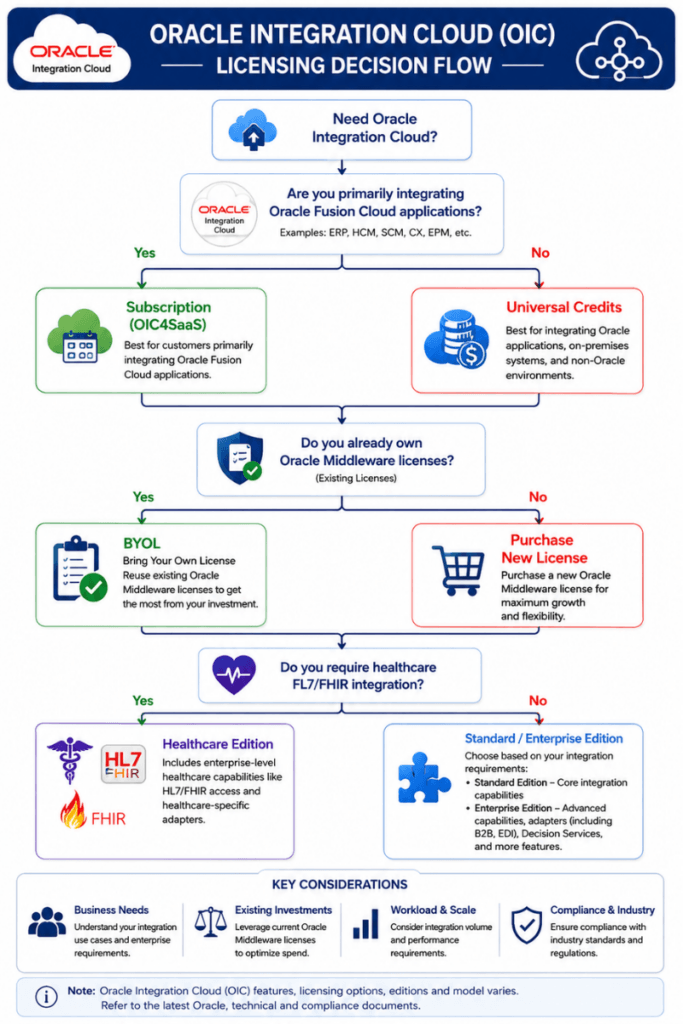
Rather than starting with the available license names, it is often easier to approach the decision from a business perspective. The following decision flow illustrates a practical way to determine the most suitable OIC licensing model.
Reference Documentation: Oracle Integration License Types Documentation