AI Agents in Oracle Fusion Cloud: A Practical Guide to Intelligent Automation
Oracle Fusion continues to evolve with intelligent automation capabilities powered by Artificial Intelligence. One of the powerful features introduced is the AI Agents, which help automate business processes, assist users with decision-making, and perform tasks autonomously within Oracle Fusion applications. AI Agents can analyze business data, execute predefined tools, and collaborate with other agents to complete complex workflows.

What is an AI Agent in Oracle Fusion?
An AI Agent in Oracle Fusion is an intelligent automation component that can understand business context, access Oracle Fusion business objects, execute tools, and perform specific tasks to assist users or automate processes. These agents operate using predefined logic, integrations, and tools to interact with Oracle Fusion data and services.
AI Agents can perform tasks such as:
- Retrieving business data
- Executing transactions
- Performing validations
- Automating workflows
- Assisting users with decision-making
- Integrating with external systems
Why Do We Need AI Agents?
Organizations today handle large volumes of enterprise data and complex workflows. Manual interaction with systems often slows down decision-making and reduces productivity.
AI Agents help solve these challenges by enabling intelligent automation.
Business Benefits of AI Agents
- Automation of repetitive business processes: Handle routine queries and operational tasks automatically.
- Faster decision making using real-time data: Users can retrieve insights instantly without navigating multiple application pages.
- Improved productivity: Employees can focus on strategic tasks instead of routine system interactions.
- Intelligent access to enterprise data: Can interpret user queries and fetch relevant data from Oracle Fusion modules.
- Scalable automation across departments: Can support procurement, finance, HR, SCM, and other enterprise functions.
Components of Oracle Fusion AI Agents
Business Objects
A Business Object in Oracle Fusion AI Agents represents structured business data that the AI agent can work with. Instead of directly connecting to database tables, these business objects are built on top of secured REST APIs provided by Oracle Fusion.
These APIs expose data like purchase orders, invoices, suppliers, employees, etc., so the AI agent can fetch and process information in a secure and controlled way.
Example: If a user asks, “Show me open purchase orders,” the AI agent will pull the required data from the Purchase Order business object and display the results to the user.
Agent Tool
An Agent Tool is a capability that allows an AI agent to perform a specific action. It helps the agent interact with REST APIs, Oracle Fusion services, business objects, or even external systems.
In simple terms, Agent Tools are what give the agent the ability to execute tasks.
Agent
An Agent is the intelligent component that directly interacts with the user. It acts like an AI assistant that understands user queries and determines how to retrieve the required information.
It takes the user’s input in natural language, identifies the intent behind the request, and then decides which tools to use to generate the right response.
Agent Team
An Agent Team is a collection of multiple AI agents that are grouped together and managed as a single unit. Instead of relying on one agent to handle everything, an Agent Team brings together different specialized agents, each designed for a specific domain or type of task.
When a user raises a request, the Agent Team helps in routing that request to the most relevant agent or even coordinating between multiple agents if needed. This makes it easier to handle complex scenarios where input from different areas like finance, procurement, or HR might be required.
In simple terms, an Agent Team acts like an orchestrator; it ensures the right agent (or combination of agents) is used to process the request and deliver the best possible response.
Simple Representation
- Business Object → Data
- Agent Tool → Action on Data
- Agent → AI Assistant
- Agent Team → Group of AI Assistants
Workflow Agent
One of the most significant enhancements to AI Agent Studio is the introduction of Workflow Agents. Workflow Agents allow developers to design structured business processes using visual workflow nodes rather than relying solely on prompt engineering.
Workflow Agents support:
- Conditional branching
- Sequential processing
- Parallel execution
- Error handling
- Human approvals
- Agent collaboration
- External integrations
This enables AI to orchestrate complete business processes instead of answering isolated questions.
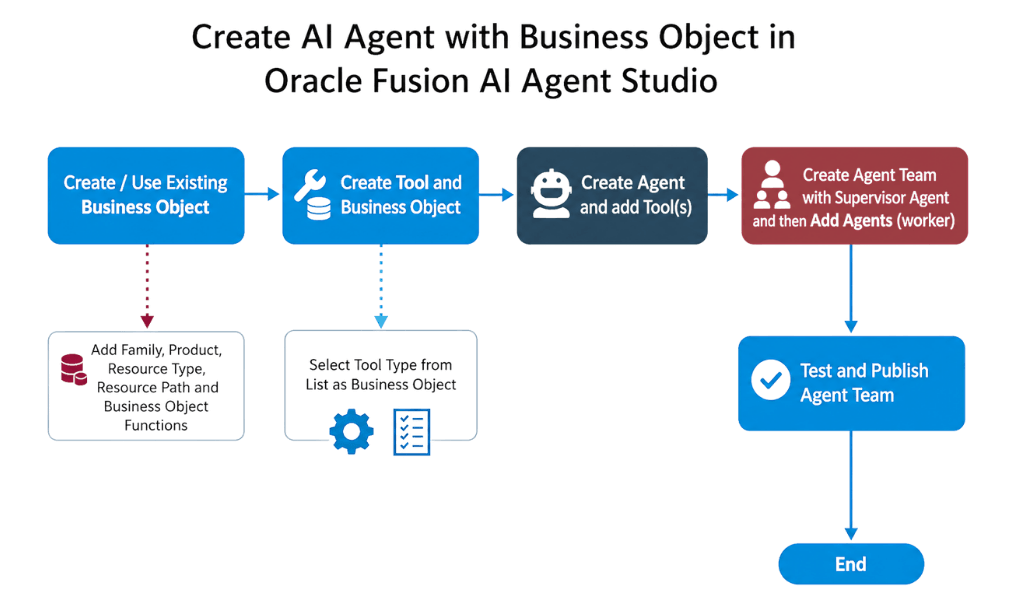
Flow Diagram for Agent Creation
The diagram below illustrates the AI Agent architecture and execution flow, showing how user input is processed through agents, tools, and Oracle Fusion business objects to generate a response. Arrows indicate the sequential flow, while dotted arrows represent configuration dependencies
Quick Guide to the Flow
- Create / Use Existing Business Object: Define or reuse structured business data via secured REST APIs.
- Create Tool and add Business Object: Configure tools that enable actions on the data.
- Create Agent and add Tool(s): Build the AI agent and assign relevant tools.
- Create Agent Team: Group agents under a supervisor for orchestration.
- Test and Publish: Validate functionality in a non-production environment and deploy the agent team.
- End: AI Agent is ready for enterprise use.
Real-World Use Case Example
Scenario
A user asks: “Why is this supplier invoice on hold?”
Flow
- The Agent retrieves invoice details
- The Business Object pulls PO, receipt, and invoice data
- The Agent Tool performs a 3-way match validation
- The Agent Team identifies mismatch (price/quantity)
- Response explains the issue and suggests next steps
Outcome
Faster resolution of invoice holds and reduced dependency on finance teams.
Prerequisites
Before implementing AI Agents in Oracle Fusion, ensure:
- Appropriate Oracle Fusion Cloud release with AI capabilities
- Generative AI features enabled and licensed
- Access to secured REST APIs
- Proper role-based access control configured
- Non-production environment available for testing
Challenges and Resolutions
Challenges in Implementing AI Agents
- Understanding how to design effective business objects. Requires knowledge of Oracle Fusion REST API structure and data models.
- Mapping REST APIs correctly. Incorrect endpoint or parameter mapping can lead to incomplete or failed data retrieval.
- Ensuring secure access to enterprise data. Business objects must only expose data that is appropriate for the agent’s intended scope.
- Designing appropriate agent tools for automation. Tools must be scoped precisely to avoid agents performing unintended actions.
- Managing access roles and permissions. Incorrect role assignments can expose sensitive data or block legitimate agent operations.
Resolutions
- Define clear business requirements before building AI agents. Thorough scoping reduces rework during development and testing phases.
- Use secured REST APIs for business object creation. Oracle Fusion’s secured REST APIs ensure data is accessed in a controlled and auditable way.
- Test agents thoroughly in non-production environments. Validate both functional and security behaviour before moving to production.
- Continuously monitor agent performance and responses. Ongoing monitoring helps identify gaps in agent logic and data coverage.
- Follow Oracle’s RBAC guidelines for role assignment. Align AI agent roles with existing organizational security policies to prevent access violations.
Conclusion
AI Agents in Oracle Fusion represent a major step forward in enterprise automation. By combining artificial intelligence with business process execution, they enable organizations to move from manual operations to intelligent, self-driven workflows.
These agents not only improve efficiency and productivity but also transform how users interact with enterprise systems through natural language and automation.
As organizations continue their digital transformation journey, AI Agents will play a critical role in building smarter, more responsive, and scalable enterprise applications.