Develop Intelligent Integrations: The Next Evolution with Agentic AI, LLMs, and Modern Integration Platforms
In the previous article, we explored how Agentic AI differs from traditional integration approaches and discussed its key advantages and limitations. This leads to the next important question for integration architects: Where does Agentic AI add value, and which integration use cases are good candidates for agentic capabilities?

This article explores practical, enterprise-focused use cases where Agentic AI can be applied to modern integration architectures, not as a replacement for traditional integrations but as an intelligence layer that enhances their capabilities.
With the rise of Agentic AI, Large Language Models (LLMs), and powerful AI services, the traditional role of integrations is undergoing a profound transformation. Unlike conventional integrations that simply move data from point A to point B, intelligent integrations powered by AI can now trigger actions autonomously, make smart decisions, and process unstructured data (PDFs, images, emails, etc.) without custom scripting or complex coding.
By combining AI services (such as OCI AI, Azure AI, AWS AI, Google AI, or OpenAI APIs) with robust integration platforms like Oracle Integration Cloud (OIC), MuleSoft, Boomi and others, organizations can unlock powerful automation and intelligence-driven use cases.
The goal is not to introduce AI into every integration. Instead, the opportunity lies in identifying scenarios where AI-driven reasoning, unstructured data processing, or autonomous decision-making can deliver measurable business value.
In this article, we explore three high-impact scenarios that demonstrate how Intelligent Integrations can move beyond simple system connectivity and enable a new generation of enterprise automation.
1. Using Generative AI Document Analysis Capabilities:
Problem:
Accounts Payable teams often receive invoices in PDFs or email attachments, with information presented in different formats and layouts. Manually reviewing these documents, extracting invoice details, validating them against organizational policies, and entering the data into ERP systems is time-consuming, error-prone, and difficult to scale. Traditional integrations also struggle when the required information is contained in unstructured documents rather than structured API or database data. Generative AI and intelligent document processing can transform this process by automatically understanding invoice documents and initiating the downstream integration flow.
Solution:
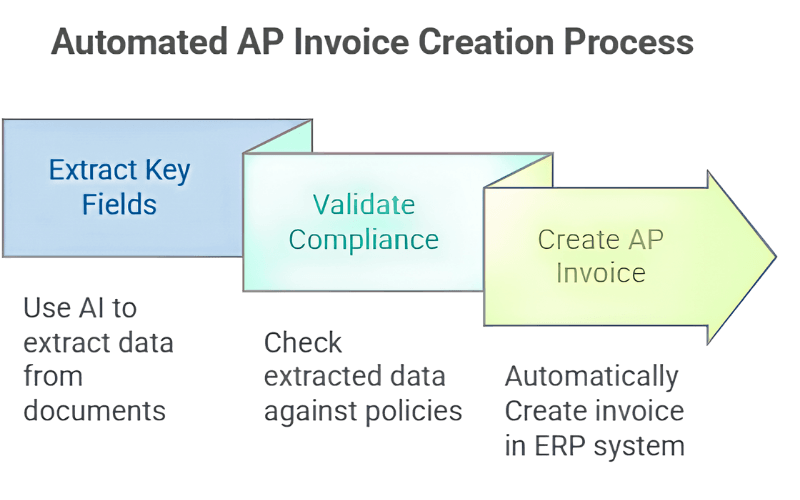
Invoice Automation: Automated Invoice creation by using Documents
The solution uses OCI Document Understanding or Vision AI to extract key invoice fields such as Invoice Number, Vendor, Invoice Date, Amount, and Line Details from PDF or email attachments. The integration can then analyze relevant organizational policy and compliance documents using the same AI capabilities to determine whether the invoice meets defined business rules and approval criteria.
Once the invoice passes validation, the integration automatically creates the Accounts Payable invoice in Oracle Fusion ERP, SAP, or another ERP system. This creates an end-to-end intelligent workflow—from document ingestion and understanding to validation and ERP transaction creation—with minimal human intervention.
Benefits:
- Near-zero manual data entry- Automatically extracts invoice information and eliminates repetitive adding data into ERP systems.
- Built-in compliance checks – Validates invoices against organizational policies and compliance requirements before creation.
- Faster processing and reduced errors – Automates document review and invoice creation, significantly reducing processing cycle time.
- Significant cost savings in Accounts Payable – Reduces manual effort and operational overhead, allowing AP teams to focus on exceptions and higher-value activities.
2. AI-Agent to Agent Integration:
Problem:
Enterprise processes often span multiple business systems and teams. For example, a sales opportunity identified in Salesforce may require Procurement and Supply Chain teams to determine whether sufficient inventory is available, whether additional supply can be sourced, and whether the organization can fulfill the opportunity.
Today, this often involves manual coordination, multiple system lookups, emails, and human decision-making, which can delay response times and increase the risk of stockouts or lost sales. Traditional integrations can move data between these systems, but they typically lack the ability to understand business intent, reason over information, and take the next appropriate action.
This touches on the next evolution of AI-driven system orchestration where multiple AI Agents of different system work together using Integrations. Instead of systems exchanging raw data, AI Agents exchange intent and insights, with Middleware tools serving as the cognitive bridge that understands, interprets, and acts.
Solution:
Intelligent Purchase Requisition Creation Based on Upcoming Opportunities
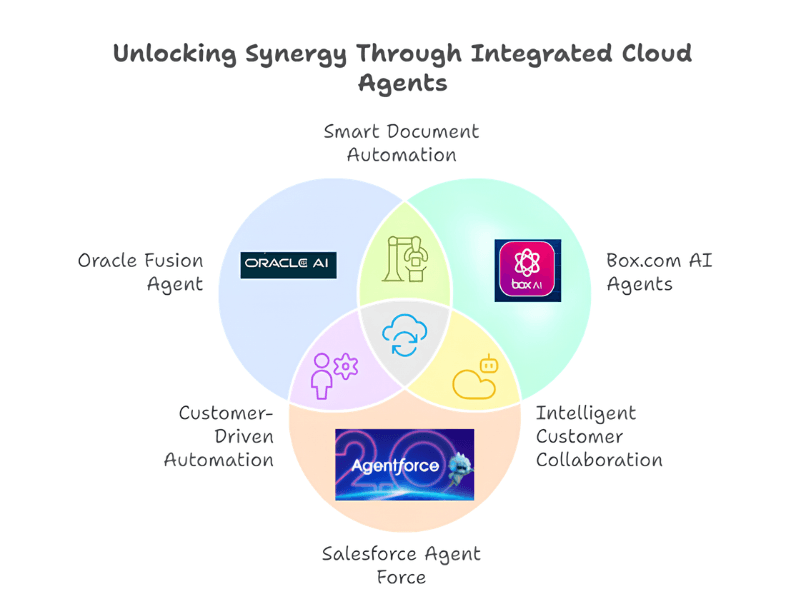
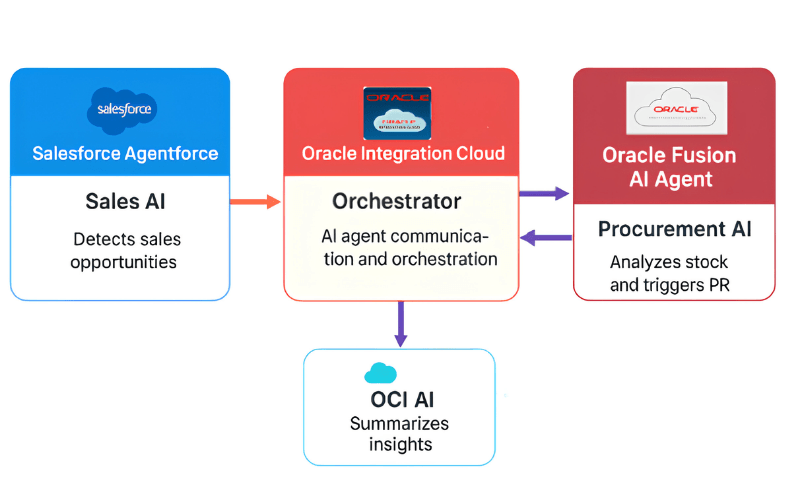 Salesforce Agentforce detects a sales opportunity for 5,000 units of Product X and triggers an API call to Oracle Integration Cloud (OIC). OIC orchestrates the process by invoking an Oracle Fusion AI Agent to check on-hand inventory, supplier lead times, and open orders. The OIC using OCI AI aggregates insights to assess fulfillment of feasibility. If a shortage is detected, OIC initiates a Purchase Requisition in Oracle Fusion or just sends summary insights in an email to stakeholders of Procurement, necessary to the Sales Team.
Benefits:
- Real-time supply chain decisions without human intervention – AI agents can analyse sales and supply information and initiate appropriate actions without waiting for manual coordination.
- Prevents stockouts and lost sales – Identifies potential supply shortages early and enables Procurement to initiate replenishment before demand is impacted.
- Seamless collaboration between Sales, Procurement, and Supply Chain teams – Connects Sales, Procurement, and Supply Chain processes through a common intelligent orchestration layer.
- Reduces manual coordination across systems – Eliminates repetitive system lookups, emails, and handoffs required to assess fulfilment feasibility.
3.Using AI Language Services
Problem:
Customer support teams receive a large volume of service requests through emails and attachments, often written in different languages and with information presented in unstructured formats. Support agents must manually read and interpret the request, identify the customer’s intent, extract relevant information, create a Service Request (SR), and respond to the customer. This manual process can result in delayed ticket creation, inconsistent categorization, language barriers, and increased workload for support teams.
Solution:
Automate Service Request Creation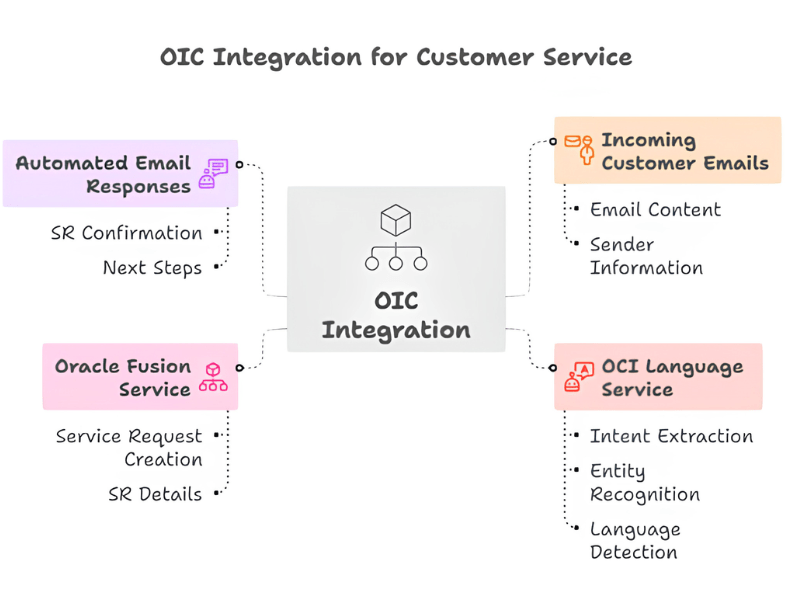
An intelligent OIC integration can automate the end-to-end Service Request creation process by processing incoming customer emails and using OCI Language Service to identify the customer’s intent and extract key entities such as customer details, issue type, product, and relevant reference information.
The solution can also perform language detection and translation when customers submit requests in languages other than English for example, translating a German customer email into English for analysis and SR creation.
Once the request is analyzed, OIC automatically creates a Service Request in Oracle Fusion Service or another target system with the relevant information. The integration can then send an automated response to the customer containing the SR number and relevant request details.
This creates an intelligent, automated flow from customer email → intent and entity extraction → language translation → SR creation → customer notification, with minimal human intervention.
Benefits:
- Instant and accurate ticket creation — Automatically analyzes customer requests and creates SRs with the relevant information, reducing manual data entry and classification errors.
- Multilingual customer support — Detects and translates incoming requests, enabling support teams to process customer issues without manual translation.
- Faster response and improved customer satisfaction — Automatically creates the SR and sends confirmation details to customers, reducing response time.
- Reduced workload for support agents — Eliminates repetitive email reading, data extraction, ticket creation, and acknowledgment activities.
- Consistent request classification — Uses AI-based intent and entity extraction to apply a consistent approach to categorizing customer issues.
- 24/7 automated support intake — Enables customer requests to be captured and processed even outside normal support operating hours.
Conclusion
Traditional integrations remain the reliable backbone of enterprise connectivity—moving data accurately and securely. However, Agentic AI is redefining the future of integrations, transforming them from passive data pipelines into active, intelligent orchestrators that understand context, make decisions, and act autonomously.
The smartest enterprises will embrace both worlds:
- Traditional integration for reliability and scale
- Agentic AI-powered integrations for agility, intelligence, and competitive advantage
By combining modern integration platforms with AI services, organizations can automate complex processes, eliminate manual effort, and deliver outcomes that were previously impossible.
Ready to build your Intelligent Integration? Contact Apps Associates to know how Agentic AI can transform your business processes today.