When Finance and HR Finally Speak the Same Language
How Oracle EPM Workforce Planning and Oracle HCM work together to give organizations the strategic clarity they’ve always needed — but rarely had.
The Problem Worth Solving
A Familiar Story: Two Teams, Two Systems, One Costly Disconnect
Across every industry we support—from manufacturing to healthcare—the same pattern shows up. Finance is building labor cost models in spreadsheets,- HR is managing salaries and open positions in another system, and someone is stuck reconciling the two every month, hoping the numbers line up.

The results are predictable: budget issues appear too late, hiring slows under disconnected approvals, and leadership makes decisions on stale data. This isn’t a technology problem—it’s a structural one. What’s missing is a governed framework linking planning decisions to operational execution.
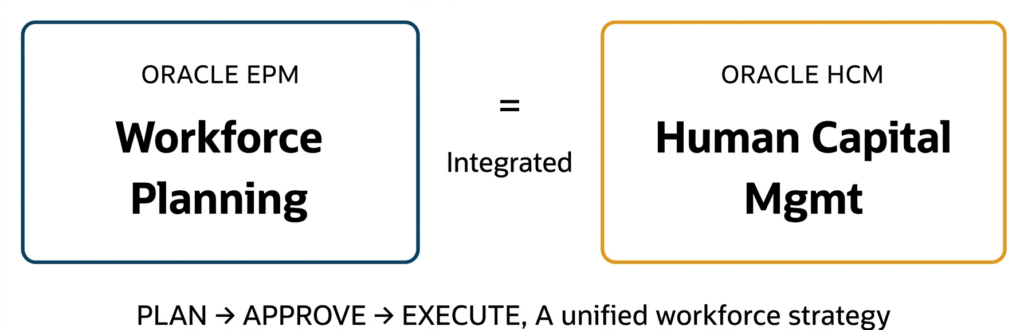
That’s exactly where Oracle’s ecosystem delivers. When Oracle EPM Workforce Planning and Oracle HCM operate together under the right governance, organizations fundamentally shift how they plan, manage, and execute workforce strategy. In our Apps Associates practice, we’ve watched this turn workforce planning from a reactive, manual process into a forward‑looking, disciplined capability.
The objective is not simply to connect two systems. It is to establish a single, authoritative framework where Finance and HR operate from shared data — and where every workforce decision carries a clear audit trail from plan to execution.
Understanding The Tools
Two Systems, Two Distinct Roles — One Integrated Strategy
Before looking at how these platforms work together, it’s critical to be clear about what each is designed to do—and what it isn’t. That clarity is the foundation of every successful implementation. In our work, we anchor this distinction in a simple principle: EPM is the system for planning and forecasting; HCM is the system of record and execution.
EPM captures what the organization intends to spend—planned positions, modeled compensation, and forecasted workforce costs. HCM captures what the organization has formally committed to—approved positions, recorded compensation, and active employees. These are related but not interchangeable and blurring the line between them is one of the costliest mistakes an implementation can make.
Who Benefits
A Platform for Every Workforce Stakeholder
One of the most common and costly misconceptions about an EPM or HCM initiative is treating it as a technology project. It isn’t. It is an organizational shift that touches every function involved in workforce decisions.
Finance and Budget teams use EPM to build labor budgets, model staffing costs, and evaluate scenarios before any hiring action is taken. HR Business Partners rely on the platform to validate compensation structures and confirm that proposed positions align with grade frameworks and regulatory requirements. Department managers gain a structured way to request staffing with full visibility into cost center impact. Meanwhile, HR Operations maintains- the authoritative records in HCM- the official employee data that continuously feeds actuals back into EPM, keeping forecasts anchored to reality.
The Integration Model
Governing the Workflow: Plan, Approve, Execute
Organizations get the most value from an EPM–HCM integration not by building complex architectures, but by establishing clear, enforced governance before anything is configured. Technology enables the work; governance determines the outcome.
The principle is straightforward: plan and model in EPM; execute in HCM. A position starts in EPM as a proposal- costed, modeled, and approved. Once approved, it moves into HCM via a bulk load or manual creation- it is never automatic. Only then is the official position created and recruiting begins. Actual headcount and compensation data flow back into EPM on a set cadence, keeping forecasts tight and accurate.
The Business Case
The business case for unifying your EPM and HCM strategies is strong. Across every implementation we’ve lead, the results are strikingly consistent:
Key benefits of a united EPM-HCM Strategy
- Accurate Labor Cost Forecasting
- Finance & HR Alignment
- Faster Budget Cycles
- Full Audit Trail & Governance
- Real-time Workforce Analytics
- Elimination of Manual Processes
Budget cycles shrink from weeks to days. Headcount variances surface in real time—not months later. And the longstanding inefficiency of Finance reconciling against HR—and HR against Finance—largely disappears because both teams finally operate- from the same governed data set.
Just as important is what this model removes from HCM: the manual burden of tracking position budgets, something HR operations was never designed to do. When HCM uses the approved headcount budgets from EPM as its basis, the system enforces controls at the point of hire—preventing over-commitment up front rather than trying to account for it after the fact.
An Honest Assessment
The Challenges Are Real — and Entirely Manageable
We would be doing organizations a disservice if we highlighted the benefits of this model without being equally direct about the risks. Any integration of this scope comes with friction, and the teams that succeed are the ones that anticipate those challenges early.
| Strategic Advantages | Risks & Mitigations |
|---|---|
| Clear HR vs. Finance accountability | Duplicate entry (mitigate: one-way creation model) |
| What-if modeling before commitments | Timing gaps between systems (mitigate: scheduled sync) |
| Built-in budget controls & audit trail | Ownership confusion (mitigate: clear RACI policy) |
| Faster cycles with automated burden rates | Data governance drift (mitigate: enterprise structure governance) |
| Continuous forecast accuracy from actuals |
The most common issue we encounter is ownership ambiguity– a lack of clear, enforced accountability for who owns which data elements. The solution isn’t technical; it’s organizational. A well-defined- RACI, backed by a firm policy that planning belongs in EPM and execution belongs in HCM, removes most of this ambiguity before it becomes operational debt.
For organizations spanning multiple entities or business units, shared reference data requires focused attention from day one. Job codes, grade structures, and cost center mappings are foundational to both systems. Misalignment here won’t show up as a configuration error—it will surface months after go-live as a data quality problem, exactly when the organization has the least time or tolerance to deal with it.
Implementation Guidance
What We Recommend Before the First Configuration Decision
For organizations beginning this journey, one message bears repeating: the order of decisions matters as much as the technology itself. The costliest rework we see in EPM-HCM implementations rarely stems from technical mistakes—it comes from governance and architecture decisions made too late in the process.
Start with governance, not configuration. Before a single system is built, define—jointly with Finance and HR—how positions are proposed, who approves them, and when a planned position becomes an official one in HCM. The swim-lane is not an output of implementation; it is a prerequisite for it.
Next, define the integration data model early. The data flowing between EPM and HCM—job codes, identifiers, salary rates, FTEs, cost centers—must be documented and validated upfront. Changing this after go live carries a cost few organizations anticipate-.
Treat rate tables as strategic infrastructure. EPM’s ability to model benefits, and tax rates is powerful, yet often under-governed. Every forecast and scenario depends on accurate, well managed rates. Ownership, workflow, and update cadence must be formalized before -go live-.
Finally, design for sustained data quality—not just launch-day accuracy. The strongest implementations are the ones that treat HCM data integrity as an ongoing operational discipline. EPM forecasts are only as trustworthy as the actuals feeding them, and actuals are only as strong as the processes keeping HCM a true system of record.
The organizations that realize the most value from this integrated model are not those with the most sophisticated configurations. They are those that built their implementation around a principle of organizational alignment — and held Finance and HR jointly accountable for its success.
Closing Perspective
Workforce Costs Are an Organization’s Largest Line Item. They Deserve a Plan to Match.
For most organizations, employee related costs make up 50–70% of total operating spend-. Yet the processes used to plan, forecast, and govern those costs are often the least mature- held together by spreadsheets, disconnected tools, and manual reconciliations that generate significant effort but limited trust from leadership.
When Oracle EPM Workforce Planning and Oracle HCM are implemented together under strong governance, the operating model changes entirely. Finance and HR work from the same authoritative data. Budget approvals happen before commitments are made. Variances surface in real time—not during a quarterly review when it is too late to act.
Across industries and operating models, we’ve guided organizations through this transformation. The consistent lesson is simple: the barrier is almost never technical. The real question is whether the organization is ready to adopt the governance discipline required for the technology to deliver its full value.
If this resonates with challenges your organization is navigating,
we welcome the conversation. Whether you are evaluating Oracle EPM and HCM for the first time or working to optimize an existing implementation, our practice brings both the technical depth and the organizational experience to move the work forward with confidence.