How to Resolve Tax Calculation Limitations in Oracle EBS for Invoices with Negative Lines
In Oracle E-Business Suite, the system automatically generates payable invoices and pushes them directly into Oracle AP. Upon validation, the standard Oracle India TDS functionality triggers the creation of a credit memo against the vendor for the tax amount. Simultaneously, a separate AP invoice is generated for the ‘Commissioner of Income Tax’ to facilitate the remittance of these funds to the Government of India.

The current Oracle standard functionality fails to calculate tax on invoice lines with negative amounts. This gap in tax logic leads to an incorrect calculation, resulting in an overstated tax deduction from the vendor and, consequently, an excessive remittance to the Government of India. This inaccuracy creates both a financial discrepancy and a significant reconciliation burden for the finance team.
Technical & Financial Impact
The absence of tax calculation on negative line items creates a cascading financial impact across our AP ledger. Because the system calculates the TDS based solely on positive lines—while failing to net out the negative adjustments—the resulting tax deduction is mathematically higher than the actual net liability.
Beyond the immediate over-deduction from the vendor, this process introduces significant operational risks:
- Reconciliation Issues: The finance team must manually intervene to correct TDS amounts, increasing the monthly close cycle time.
- Compliance Risks: Inaccurate tax reporting to the Government of India exposes the organization to potential audit queries and regulatory scrutiny.
- Vendor Dissatisfaction: Over-deducting tax negatively impacts vendor relationships and requires time-consuming manual credit note adjustments to rectify the balance.
Solution Architecture
To ensure that a correct tax amount is deducted from the vendor and remitted to the Government of India, the correct tax amount is calculated manually and a TDS correction Invoice against the vendor and a Credit Memo against Commissioner of Income Tax is created manually.
However, this manual correction approach is very tedious and is consuming a lot of resources from AP Finance Team. It is becoming extremely difficult to handle this manual process for every AP Invoice generated from the source system invoices which are holding negative lines.
Example:
In the example below, the total vendor invoice amount is INR 88,176.24. There is a TDS rate of 10% for this author. So, the correct tax amount to be deducted from the author and to be remitted to Commissioner of Income Tax is 8,817.62. However, there are few negative lines on the Invoice and as a result the Standard Oracle functionality ignored those lines and calculated tax only on the positive lines. System calculated tax amount is 9,449.00.
As a result, a TDS correction Invoice was created manually for an amount of 631.38 which is the difference of 9,449.00 and 8817.62. Also, a Credit Memo was created manually against the Commissioner of Income Tax for an amount of 631.38.
| Actual calculation | Present calculation in Oracle | ||
| Invoice amount | Tax 10% | Invoice amount | Tax 10% |
| 89,709.22 | 8,970.92 | 89,709.22 | 8,970.92 |
| 4,621.06 | 462.11 | 4,621.06 | 462.11 |
| 160.44 | 16.04 | 160.44 | 16.04 |
| -3,492.23 | -349.22 | -3,492.23 | The -ve lines are ignored by system while calculating the Tax |
| -2,661.81 | -266.18 | -2,661.81 | The -ve lines are ignored by system while calculating the Tax |
| -160.44 | -16.04 | -160.44 | The -ve lines are ignored by system while calculating the Tax |
| 88,176.24 | 8,817.62 | 88,176.24 | 9,449.07 |
Yellow = Total Invoice Amount
Green = Correct Tax Amount
Pink = System Calculated Tax Amount
As per standard functionality Oracle will create below three invoices
| Type | Trading Partner | Supplier Num | Invoice Num | Invoice Currency | Invoice Amount |
| Standard | vendor | 12345 | Original invoice Num | INR | 88,176.24 |
| Credit Memo | vendor | 12345 | Credit invoice Num | INR | -9,449.00 |
| Standard | Commissioner of income tax | 12345 | Standard invoice Num | INR | 9,449.00 |
The proposed solution will generate below two invoices to fill the gap and match the values.
| Type | Trading Partner | Supplier Num | Invoice Num | Invoice Currency | Invoice Amount |
| Standard | vendor | 12345 | Correction Invoice-SN | INR | 631.38 |
| Credit Memo | Commissioner of income tax | 12345 | Correction Invoice-CN | INR | -631.38 |
Solution Summary
Flow Diagram: Automated TDS Correction Process for Invoices with Negative Lines
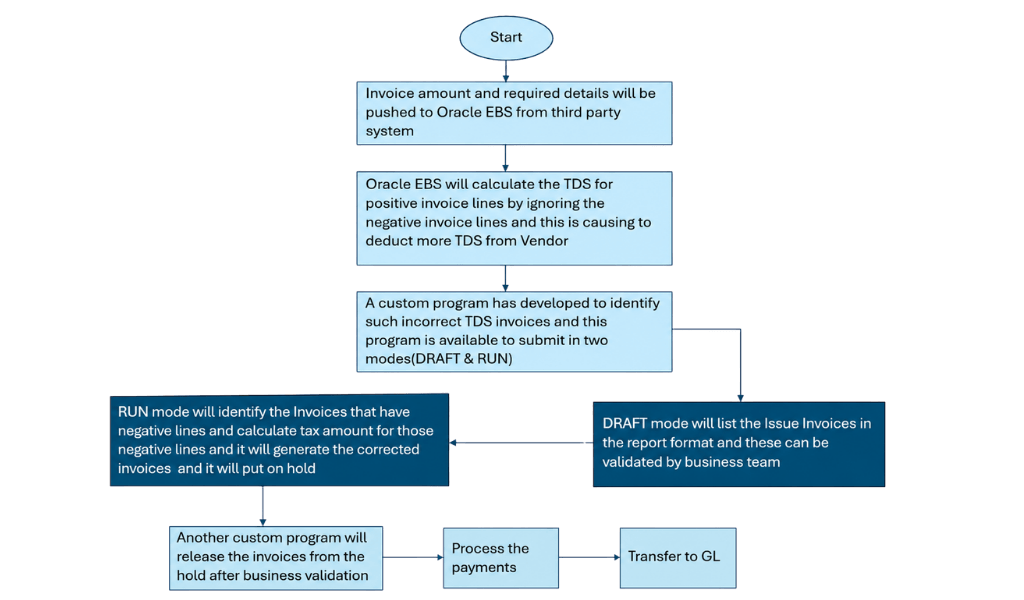
After the Invoice details are pushed into Oracle EBS from the third-party system, the TDS Invoice and Commissioner of Income Tax Invoice are created in Oracle:
- A custom program has been designed that will do the following:
- This custom program is available to be submitted in two modes which are DRAFT and RUN. DRAFT mode will list the issue invoices in the report format and same will be validated by the AP finance team for which the higher TDS amount is deducted from the vendor.
- In RUN mode it will identify Invoices that have negative lines and calculate tax amount for those negative lines by using the tax percentage used for positive lines
- Also, it will create a correction invoice(standard) against the vendor for the amount identified in step (b) and put it on hold
- Create the credit memo against Commissioner of Income tax for the amount identified in step (b) and place it on hold
- Another custom program has been designed to release the invoices from the hold.
- Create Accounting program will pick these corrected invoices and validate them. Payment process will kick off, and these transactions will be moved to general ledger as per the standard process.
Business Value
By automating the TDS correction process, we have eliminated human error and significantly reduced the manual workload for the business team. This initiative saves approximately 2 weeks per month across impacted invoices, moving us from a labor-intensive cycle to a streamlined, sustainable, and zero-cost operational model. Furthermore, this automation has mitigated our risk of compliance issues and greatly improved our audit readiness. Moving forward, this framework provides a scalable foundation that can be easily adapted to address future tax regulatory changes with minimal effort.
Forward-Looking Conclusion:
- While this phase focuses on TDS correction, the automation framework is designed for modularity. Future iterations could integrate similar logic for other tax compliance reports, further reducing operational overhead and strengthening our overall financial reporting capabilities.
Conclusion
Addressing the limitations of standard Oracle tax calculations on negative invoice lines was a complex challenge that previously required time-intensive manual interventions. By developing this automated TDS correction framework, we have successfully eliminated human error and streamlined a critical financial process, saving hours of manual labor per month. Beyond these immediate operational gains, this solution has significantly improved our audit readiness and mitigated ongoing compliance risks. This scalable approach serves as a robust blueprint that can be easily adapted to resolve similar tax calculation constraints in other Oracle modules or diverse regional regulatory environments.