OIC Gen3 AI Features — Beyond Integration
From middleware to an intelligent automation platform
Introduction — The Evolution of OIC
For years, Oracle Integration Cloud (OIC) has been the backbone of enterprise middleware strategy. It connected Oracle SaaS applications, on-premises systems, and third-party platforms through pre-built adapters, orchestration flows, and event-driven messaging. If you needed to sync data between Oracle ERP and Salesforce or trigger a workflow whenever an order was placed in a supply chain system, OIC was your go-to.

The platform your team used three years ago is fundamentally different from what OIC Gen3 is becoming today.
OIC is evolving from an integration tool into an intelligent automation platform — powered by AI — similar to how modern platforms combine Integration + AI + Automation into a lightweight enterprise AI orchestration layer.
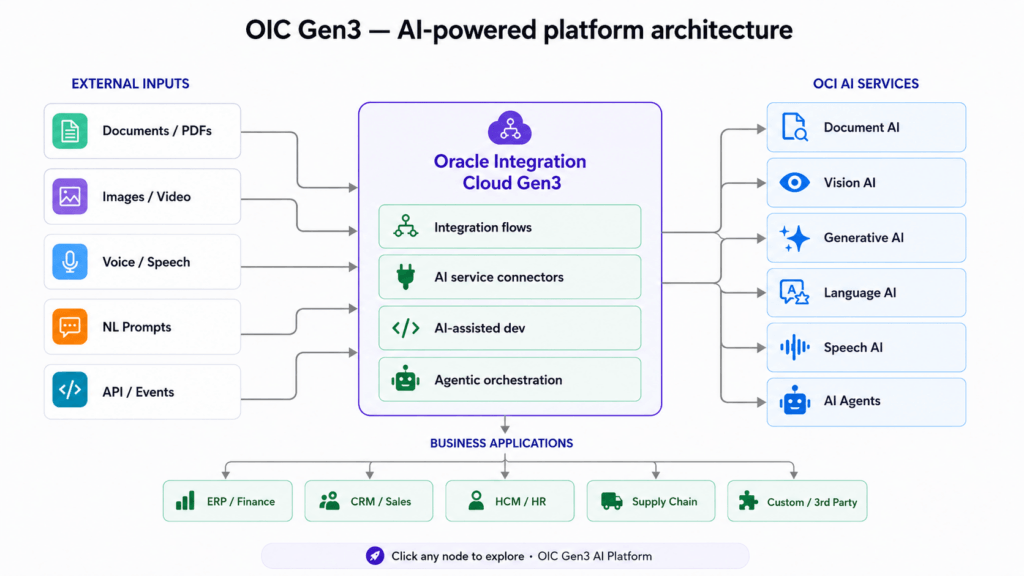
OIC Gen3 now embeds Oracle Cloud Infrastructure (OCI) AI services directly into integration flows. Developers can invoke Document Understanding, Vision AI, Generative AI, Speech recognition, and even autonomous AI Agents — all within the same integration canvas they use for API orchestration. No separate middleware layer. No complex AI plumbing. Just drag-and-drop AI into your business flows.
Key AI Features in OIC Gen3
OIC Gen3’s intelligence is powered by a combination of OCI AI services, developer-facing generative tools, and autonomous agentic capabilities. Rather than treating these as isolated features, think of them as three interconnected layers of an intelligent automation platform — each adding a distinct dimension of AI to your integration flows.
- OCI AI Services
These are the core OCI AI services that OIC Gen3 exposes as native connectors within the integration canvas. Each service can be invoked inline — as a step within your orchestration flow — without any external scripting, separate middleware, or custom infrastructure.
- Document Understanding (OCI Document AI)
OCI Document Understanding is an AI service that extracts structured data from unstructured documents — invoices, receipts, purchase orders, forms, and contracts. It uses pre-trained machine learning models that understand document layout, key-value pairs, tables, and text regions without requiring you to define field positions manually.
In OIC Gen3, this capability is surfaced as a native service connector. You invoke it inline within any integration flow, passing a document reference and receiving back structured JSON containing extracted fields.
Best suited for: Invoice processing, purchase order extraction, contract data capture, onboarding form automation. - Vision Service (OCI Vision AI)
OCI Vision AI brings image classification, object detection, and visual anomaly detection into your OIC flows. It can identify what’s inside an image — damaged goods, document types, product defects, vehicle damage — and return structured results with confidence scores. You can use Oracle’s pre-built vision models or train custom models on your own labeled image datasets.
You can use Oracle’s pre-built vision models out of the box, or train and deploy custom vision models on your own labelled image datasets through OCI Data Labeling — and reference those custom models directly within your OIC flow invocation.
Best suited for: Insurance damage assessment, quality control in manufacturing, document type classification, retail shelf monitoring. - Speech AI and Language Processing
OCI Speech AI converts audio to text with high accuracy, supporting multiple languages. When paired with OCI Language AI (which handles sentiment analysis, key phrase extraction, entity recognition, and text classification), it creates a powerful pipeline for processing voice-based customer interactions inside OIC flows.
These two services are frequently used together as a tandem pair: Speech AI transcribes the audio, and Language AI interprets the meaning, tone, and intent of that transcription — all within a single OIC orchestration.
Best suited for: Contact center automation, voice-to-ticket workflows, compliance call monitoring, customer sentiment tracking.
- Generative AI and AI-Assisted Development.
OIC Gen3 introduces AI-assisted development features that fundamentally change how integrations are created. Instead of manually configuring every adapter, building mapper transformations field by field, and writing logic expressions, developers can now describe what they want in natural language — and OIC generates substantial portions of the integration automatically.
This sits on top of Oracle’s Generative AI service (powered by large language models including Cohere and Meta Llama variants on OCI), accessed through OIC’s development environment.
AI-assisted flow generation in OIC Gen3 works best for standard, well- defined integration patterns such as: - Simple point-to-point integrations between Oracle SaaS applications
- Common ERP-to-CRM sync scenarios with predictable field mappings
- Scheduled data extract and load flows with straightforward transformations
However, for complex integrations involving multi-system orchestration, custom business logic, conditional branching across several systems, or highly domain-specific transformations, AI assistance currently plays more of a suggestive and supportive role rather than a fully generative one.
- Agentic AI — AI Agents in OIC
This is perhaps the most forward-looking capability in OIC Gen3. AI Agents are autonomous software entities that can observe context, reason about it, plan a sequence of actions, and execute those actions — calling tools, APIs, and services along the way — without step-by-step human instruction.
In OIC Gen3’s evolving architecture, AI Agents can be embedded as orchestration participants. They monitor conditions, make decisions, invoke integrations, and trigger downstream workflows — operating as intelligent, self-directing nodes within a business process.
Architecture Overview
The following diagram represents the high-level architecture for OIC Gen3.
Conclusion
Three years ago, Oracle Integration Cloud was a powerful but fundamentally conventional middleware platform. Its value proposition was connectivity — bridging Oracle applications with each other and with the rest of the enterprise technology stack.
OIC Gen3 is something qualitatively different: an AI-powered digital workflow engine that embeds intelligence into every layer of the integration process.