
Your Team’s Next Colleague Has Already Arrived
AI in the enterprise began as a helpful assistant, surfacing information, nudging decisions. Oracle’s AI Agent Application Studio marks the next evolution: AI that doesn’t just support your People Operations function, but works alongside it executing, collaborating, and operating with the autonomy of a trusted team member.
Most Organizations Are Still Writing Their AI Strategy. That’s a Competitive Advantage.
Many People Operations leaders are mid-stride in building their AI business cases, evaluating needs, establishing governance, and determining where intelligent automation delivers real return. This window of deliberation is not a delay. It is an opportunity to adopt with intention.
Oracle is building the platform to meet organizations where they are. By delivering purpose-built AI applications natively within Oracle Fusion HCM, Oracle is setting the stage for the future of People Operations. Organizations that define clear use cases now will be positioned to activate purposefully, not reactively.
“The question is no longer whether AI belongs in People Operations. It’s how clearly you can articulate what you need it to do.”
The shift from AI as assistant to AI as colleague reflects a genuine architectural change. Colleagues execute. They remember context. They act without being asked twice. Oracle’s agentic framework is built precisely around that definition.
How People, Applications, and Agents Work Together
Oracle’s framework introduces a clear three-layer model that defines how AI operates within People Operations, and where human judgment remains essential.
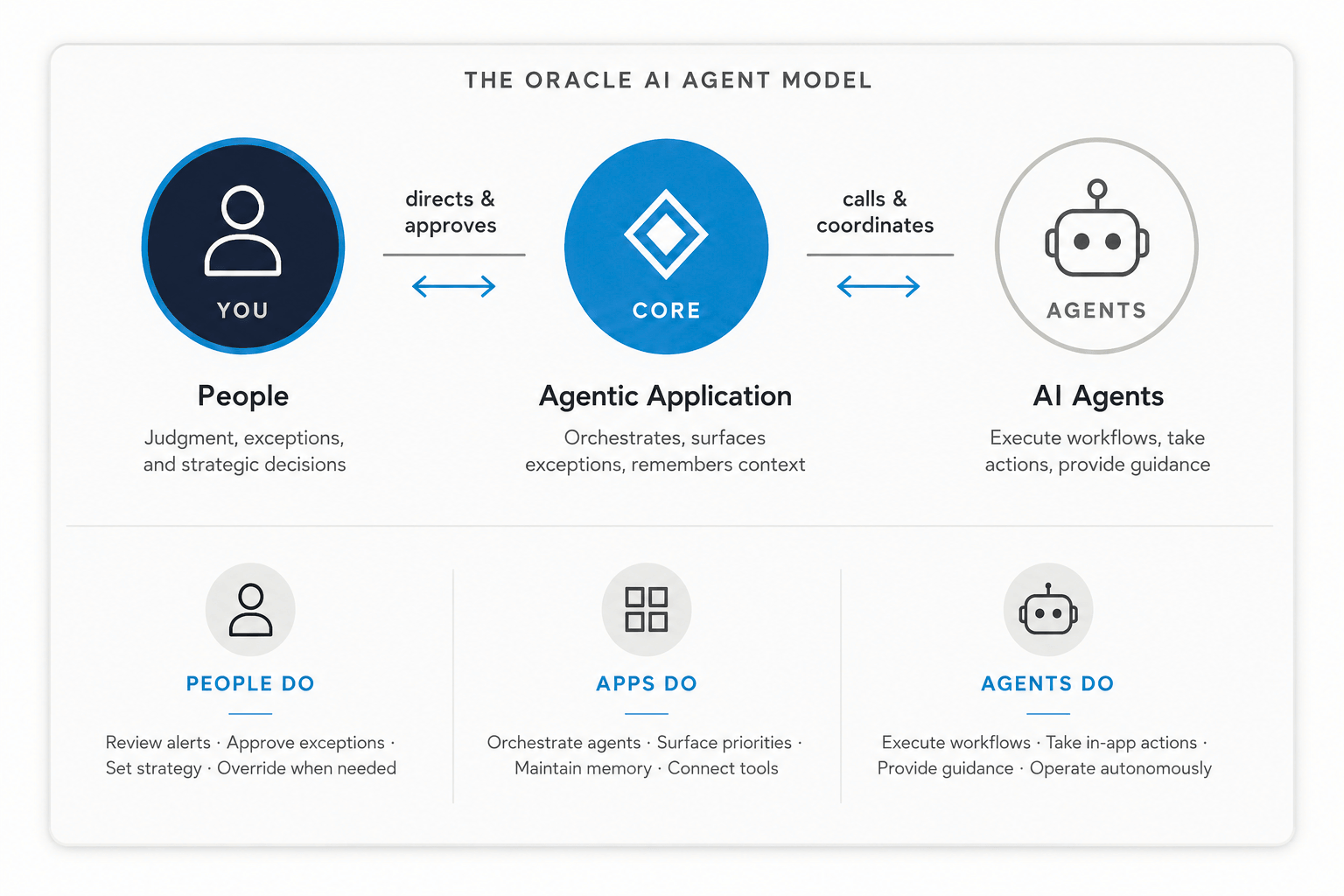
People remain the decision layer. Agentic Applications orchestrate the right agents at the right moment. AI Agents do work like executing workflows, taking in-application actions, and providing real-time guidance. An assistant waits to be asked. A colleague is already working.
Command Centers, Built for People Operations
Oracle has developed Command Centers available through AI Application licensing, each targeting a distinct, high-impact area of the employee lifecycle. These are Oracle Developed Applications available now, configurable to your workforce context, and built on the same Fusion HCM infrastructure organizations already rely on. Here’s a highlight of two of the Command Centers currently available:
Oracle Developed Applications — available with AI Application licensing Both Command Centers are built on Oracle Fusion HCM with no separate integration, no separate data model. Configurable by design and extensible via the Application Studio builder launching in 26C.
Configured for Your Workforce Context
Oracle’s persona-based application spaces are tailored to distinct industry and workforce contexts. The colleague model doesn’t look the same across every organization, and Oracle’s platform is built knowing that.
Union & Collective Bargaining
High Volume Hiring
Healthcare & Clinical
Internal Mobility
Workforce Management
The forthcoming Contracts Intelligence Console in 26C extends this further by enabling agents to reference Collective Bargaining Agreements and labor contracts at the point of decision, a capability purpose-built for union and public sector workforces. All of it runs on Oracle Fusion: same transactional capabilities, same data, same security. Seamlessly connected, not layered on top.
How to Frame Your People Operations AI Needs
The risk in evaluating AI applications is treating the process as a feature checklist. Organizations that get the most from Oracle’s agentic platform enter with clear priorities. A practical framework:
Four dimensions for evaluating agentic readiness
Start with your highest-volume, lowest-judgment workflows
Scheduling, screening, shift exceptions, form initiation. If it’s repetitive and rule-bound, an agent can own it. This is where ROI is fastest and clearest.
Segment your workforce before selecting applications
Oracle’s persona-based app spaces mean the question is which configuration fits each population, not whether one size fits all. Segment first, then select.
Define your exceptions before go-live
The Command Centers are exception-first by design. Organizations that define alert thresholds and escalation paths in advance will arrive at a briefing. Those that don’t will arrive at a backlog, in a new format.
Plan for the App Builder before it arrives
Oracle’s Application Studio builder launches in 26C, enabling organizations to configure and extend applications directly. The most prepared teams will already know what needs to change and why.
22 Agentic Applications. A Platform That Compounds.
New agentic apps across Oracle Cloud
Dedicated People Operations apps in 26C
App Builder, Contracts Console & more
Oracle is not releasing isolated features, it is building an agentic platform that compounds with every release cycle. Each new application builds on the same infrastructure, the same data model, and the same agent capabilities already in place.
Platform or feature? That’s the question that matters.
The key differentiator in evaluating People Operations AI is simple: is this platform building toward AI as a genuine colleague, or adding AI as a feature? Feature-level AI requires continuous procurement as needs grow. Platform-level AI compounds, and Oracle’s native agentic platform within Fusion HCM is built for exactly that.
For People Operations leaders building multi-year strategies, that compounding effect — and the colleague model it enables — belongs explicitly in your business case.
From assistant to colleague: start with clarity.
The organizations leading in AI-powered People Operations are not the fastest movers, they are the most intentional ones. Define your needs, map them to Oracle’s developed capabilities, and build a roadmap that grows with the platform. Work with Apps Associates to start your HCM AI Journey.