A Scalable Approach to Attachment Migration from Oracle EBS to Oracle Fusion Cloud
Attachments in Oracle systems are more than just files; they are essential pieces of information tied to key business entities, like Suppliers, Customers, or Sales Orders. They could include contracts, invoices, or supporting documents that help teams make informed decisions.

During system upgrades or migrations, organizations often face the challenge of moving large volumes of attachments from Oracle E-Business Suite (EBS) to Oracle Fusion Cloud Applications. Oracle provides standard methods like File-Based Data Import (FBDI) to upload attachments, but these have limitations:
- FBDI only supports certain entities: This restricts the types of attachments that can be migrated using this method.
- Attachments must already exist on Universal Content Management (UCM): Extra preparation is required to ensure all files are available in UCM before migration.
- Handling large files or high volumes can be challenging: Uploading thousands of attachments or very large documents can be slow, prone to failures, or cause system timeouts.
This blog explores an optimized, efficient, and more reliable approach to synchronizing attachments between Oracle E-Business Suite (EBS) and Oracle Fusion Cloud. Leveraging integrations and APIs, this method ensures seamless data flow, reduces manual effort, and enhances overall efficiency in managing attachments across enterprise systems.
Challenges
- Large File Limitations
When files exceed approximately 9 MB, uploading them often fails or becomes slow. This especially happens when moving these files into the system’s content manager, which can cause delays. - Transfer Reliability Issues
Network problems or interruptions during file uploads can lead to incomplete transfers. These partial uploads cause errors and data inconsistencies, making the upload process unreliable and sometimes forcing users to retry. - Partial Loads and Error Reconciliation
Oracle’s standard attachment load relies on separate templates for headers and lines, requiring manual cross-referencing between files. This fragmented setup increases complexity and effort in maintaining accurate relationships. As a result, it raises the risk of incorrect mappings, broken references, and time-consuming error reconciliation. - Longer Processing Time
Uploading and processing approximately 35,000 to 40,000 attachments in a single batch presents significant performance and scalability challenges. The high data volume can lead to system slowdowns, increased processing time, and potential resource contention, impacting overall system stability and throughput. - Limited Error Visibility
When something goes wrong during uploads or imports, it can be hard to quickly see what caused the problem. This lack of clear error messages makes troubleshooting slower.
Proposed Solution
To overcome these challenges, organizations can leverage Integration and APIs for attachment migration. This approach allows direct synchronization between Oracle EBS and Fusion Cloud, supporting all entity types and handling high volumes efficiently. APIs ensure data integrity, reduce manual intervention, and make the migration process faster and more reliable.
By using an API-based approach, businesses can maintain smooth operations during system upgrades, ensure critical attachments are accurately transferred.
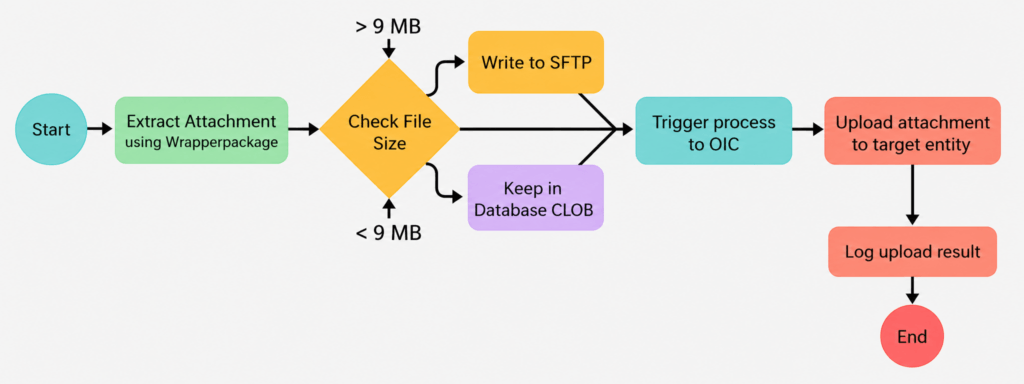
- Wrapper-Based Extraction from EBS
To make attachment management easier, a wrapper package is used to extract files from Oracle EBS. This package not only pulls the attachments but also records all extraction details directly in the EBS database. The attachment files are either stored within the EBS database (if file size is <9mb) itself or on an SFTP server(>9mb). This approach ensures that large files don’t overload the system while keeping everything organized and easily accessible.
- Automating the file attachment upload:
Oracle Integration Cloud connects directly to the EBS database for files under 9 MB and to an SFTP server for larger files. The entire process from picking up the files to uploading them into Oracle Fusion Cloud is fully automated. This not only saves time but also helps reduce manual errors and improves overall efficiency.
- Error Handling and Reporting
Uploading large numbers of attachments into UCM manually can be time-consuming and error-prone. Our automated solutions address this challenge by capturing all uploaded errors in database table columns. It also creates simple, user-friendly error reports, so you can quickly see what went wrong and fix it. This makes reprocessing failed uploads fast and reliable, improving efficiency and reducing manual effort.
Business Benefits
- Reliable System Performance: The system can handle uploads smoothly without running into timeouts or memory issues. Users are not impacted by failed uploads or waiting for the system to recover, which keeps daily operations running smoothly.
- Scalable Operations: Being able to handle thousands of attachments at once without your ERP or Fusion Cloud system slowing down. This is what scalable operations make possible. As your business grows and the volume of data increases, the system can keep up without creating bottlenecks, ensuring smooth and uninterrupted workflows.
- Accurate Data Delivery: Data is transferred consistently and in real-time, keeping your Fusion Cloud system up to date. This reduces errors, prevents missing information, and ensures that all departments have access to the most current data, supporting better decision-making and collaboration.
- Operational Efficiency: Automation reduces the need for manual monitoring, intervention, or reprocessing of failed uploads. Teams can focus on higher-value tasks instead of spending time checking and fixing data transfers, improving overall operational efficiency.
- Cost & Time Savings – Automating uploads and data migration saves time and manpower. Projects can be completed faster; operational costs are reduced. Automation transforms a time-intensive migration process into an efficient and scalable workflow.
Conclusion
By leveraging API-based integration, cloud storage, and an optimized system architecture, organizations can implement a scalable and high-performance solution for migrating attachments from Oracle EBS to Fusion Cloud. This approach minimizes system downtime, ensures reliable data transfers, and enables continuous, seamless flow of information across enterprise systems.
The solution’s built-in error logging provides detailed insights into any issues, allowing for efficient troubleshooting and accurate reprocessing of failed uploads. This ensures that all attachments are transferred securely and accurately. Overall, this methodology supports operational efficiency, data integrity, and business continuity, making attachment migration a reliable and manageable process.